 Q1
Q1
A long time ago, in Olympia, Greece, somebody founded the Olympic Games. The two main myths about its origin are the following:
Inorder to have King Oinomaos’ daughter as his wife, prince Pelops had to beat the King in a chariot race. With the help of his friend he managed to defeat Oinomaos and got what he wanted. As a celebration, Pelops founded the Olympic Games.
On Herakles’ fifth labor, he was made to clean King Augeas’ stables. In return he damanded one tenth of Augeas’ cattle. The king hadn’t kept his promise, and when the job was done, Herakles sacked Augeas’ city. In honor of his father Zeus, Herakles founded the Olympic Games.
Q2
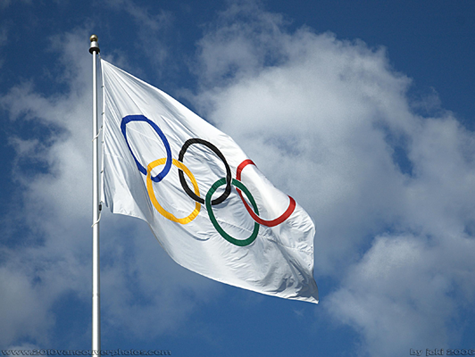
The Olympic symbol consists of five interwined rings, which represent the unity of five inhabited continents. The
Olympic Games also have a motto: Citius, Altius, Fortius, meaning "Faster, Higher, Stronger". The Olympic flag has a white background with the five rings on it. Blue, yellow, black, green and red.

Q3
The first modern Olympic games took place in Athens 1896. Back then only men had the right to participate. No women competed until 1900, when eleven women were allowed to play lawn tennis and golf. Tennis player Charlotte Cooper of England was the first woman to win an Olympic event. In 1912 women got to show off their skills in swimming. More and more events were added over time, and currently the only Summer Olympic sport women can't compete in is boxing. Which may change in near future.
Q4
The Winter Olympic Games are a multi-sport event held on snow and ice. The Summer and Winter events used to occur always in the same leap year. The last time they were held together was in 1992, after which Winter and Summer Olympics were separated. Olympics now occur in every two years.
The first winter sport event, the Nordic Games, were held in Sweden in 1901. Later some winter sports were attempted to be added to the Olympic programme aswell. Over the years skating and ice hockey were featured. In 1925 the International Olympic Committee decided to create a separate Olympic Winter Games. The 1924 games in Chamonix were designated as the first Winter Olympics. World War II interrupted Winter Olympics twice. Nowadays the Summer and winter Games are split again.
Q5
The Fundamental Principles of Olympism, as found in The Olympic Charter.
1. Olympism is a philosophy of life, exalting and combining in a balanced whole the qualities of
body, will and mind. Blending sport with culture and education, Olympism seeks to create a
way of life based on the joy of effort, the educational value of good example and respect for
universal fundamental ethical principles.
2. The goal of Olympism is to place sport at the service of the harmonious development of man,
with a view to promoting a peaceful society concerned with the preservation of human dignity.
3. The Olympic Movement is the concerted, organised, universal and permanent action, carried
out under the supreme authority of the IOC, of all individuals and entities who are inspired by
the values of Olympism. It covers the five continents. It reaches its peak with the bringing
together of the world’s athletes at the great sports festival, the Olympic Games. Its symbol is
five interlaced rings.
4. The practice of sport is a human right. Every individual must have the possibility of practising
sport, without discrimination of any kind and in the Olympic spirit, which requires mutual
understanding with a spirit of friendship, solidarity and fair play. The organisation, administration
and management of sport must be controlled by independent sports organisations.
5. Any form of discrimination with regard to a country or a person on grounds of race, religion,
politics, gender or otherwise is incompatible with belonging to the Olympic Movement.
6. Belonging to the Olympic Movement requires compliance with the Olympic Charter and
recognition by the IOC.
 Q6
Q6
Due to World War II,
the Olympic Games were cancelled twice
(in 1940 and in 1944).
Q7
Nowadays, as the Olympic Games have become very popular, they also range wider than before.
There are four different types of Olympic Games: Summer, Winter, Paralympic and Youth Olympic Games.
The first Special Olympics were held in Chicago, in 1968. The first Special Winter Games took place in february 1977 in Steamboat Springs.
 Q8
Q8
The next winter Olympic Games (2010),
officially the XXI Olympic Winter Games,
will be held on February 12 – 28 this year.
They will take place in Vancouver, Canada.
Q9
In 1936 and 1972, Summer Olympics were held in Germany. They were intended to present a democratic and optimistic Germany to the rest of the world. The first official Olympic mascot „Waldi“ also origins from there.
Q10
The long-distance foot race, the marathon, dates back to ancient times. The name comes from the legend of a Greek messenger, Pheidippides. He ran all the way from Marathon to Athens to deliver a message. When he finally got there, the only thing he could say was „We have won“, after which he collapsed.
As soon as the idea of the Modern Olympics became reality, the marathon was featured in the Games. In 1984 the first women’s marathon was introduced.

No comments:
Post a Comment